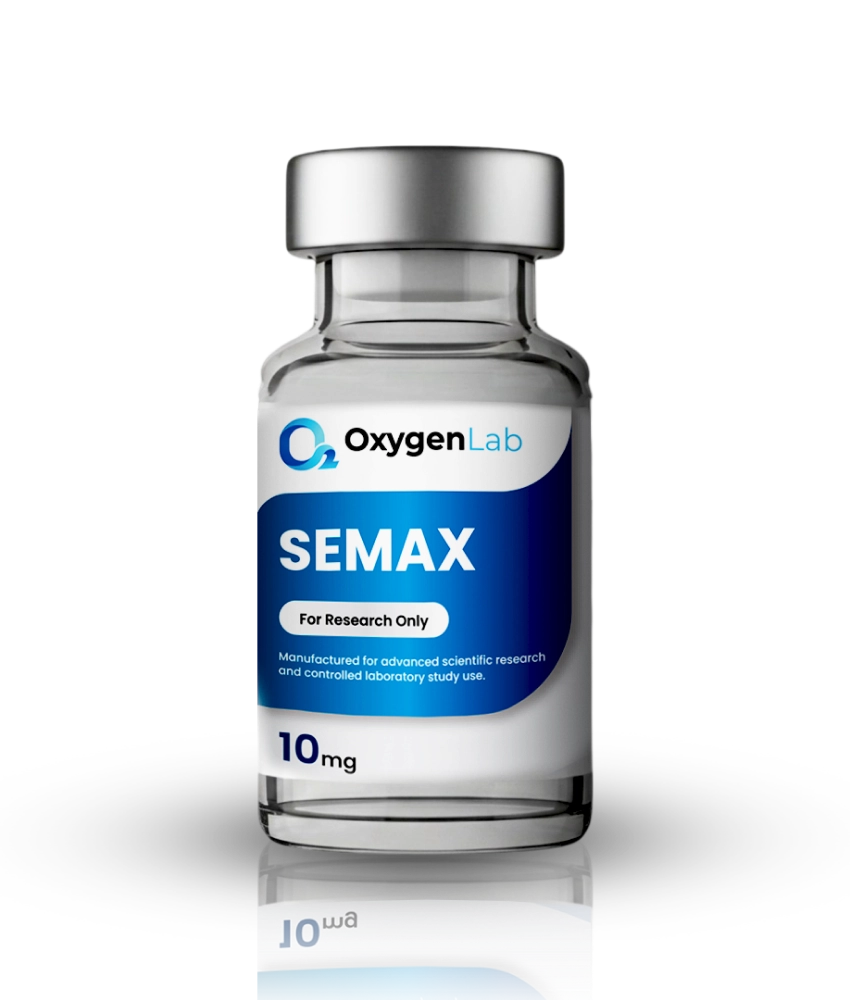

Almost every research peptide arrives as a small white “cake” or powder in a sealed vial. That form is the result of lyophilization, also called freeze-drying. Here is how it works and why it matters.
What lyophilization is
Lyophilization removes water from a frozen product by sublimation, turning ice directly into vapor under vacuum without passing through the liquid phase. The result is a dry, porous solid that keeps the molecule’s structure largely intact.
The three stages
1. Freezing
The peptide solution is frozen, usually well below 0°C, so that water forms ice crystals and the peptide is concentrated between them.
2. Primary drying (sublimation)
Pressure is lowered to a deep vacuum and a small amount of heat is applied. Ice sublimes directly to vapor and is collected on a cold condenser. This removes most of the water and is the longest stage.
3. Secondary drying (desorption)
Temperature is raised gradually to remove water still bound to the solid. The goal is a low residual moisture content, which is critical for long-term stability.
Why peptides are freeze-dried
- Stability. Many degradation reactions, such as hydrolysis and deamidation, need water. Removing it slows them dramatically.
- Shelf life. Lyophilized peptides stored cold and dry remain stable far longer than solutions.
- Shipping. A dry powder tolerates short periods at ambient temperature far better than a liquid.
- Accurate quantities. A defined mass of powder per vial makes preparation records straightforward.
What the finished product looks like
A good lyophilized peptide is usually a white to off-white cake or powder. It may look like a small pellet or a thin film, depending on the fill volume, and can break up during shipping. That is cosmetic. Clumping, stickiness or discoloration can indicate moisture uptake.
Keeping it stable after delivery
Lyophilized powder readily absorbs moisture, so store vials sealed at -20°C, let them reach room temperature before opening, and avoid repeated freeze-thaw cycles. Our storage guide covers this in detail.
Frequently asked questions
Is lyophilized the same as freeze-dried?
Yes. The two terms mean the same process.
Does lyophilization affect purity?
A well-controlled process does not change the peptide’s sequence. Purity is confirmed by HPLC on the batch certificate of analysis.
Why is there so little powder in the vial?
Research quantities are small, often a few milligrams, and freeze-dried material can collapse into a thin layer. The amount is stated on the label and specification.
Research use only. OxygenLab products are supplied for in-vitro laboratory research and analytical use only. They are not for human or animal use and are not intended to diagnose, treat, cure or prevent any disease. See our Legal & Compliance policy.
Lab tool: Working out solution concentration? Try the free OxygenLab Peptide Calculator — enter vial mass and diluent volume to get mg/mL, µg/mL and molarity.
Reconstituting a vial? Work out the final solution concentration with our peptide calculator.