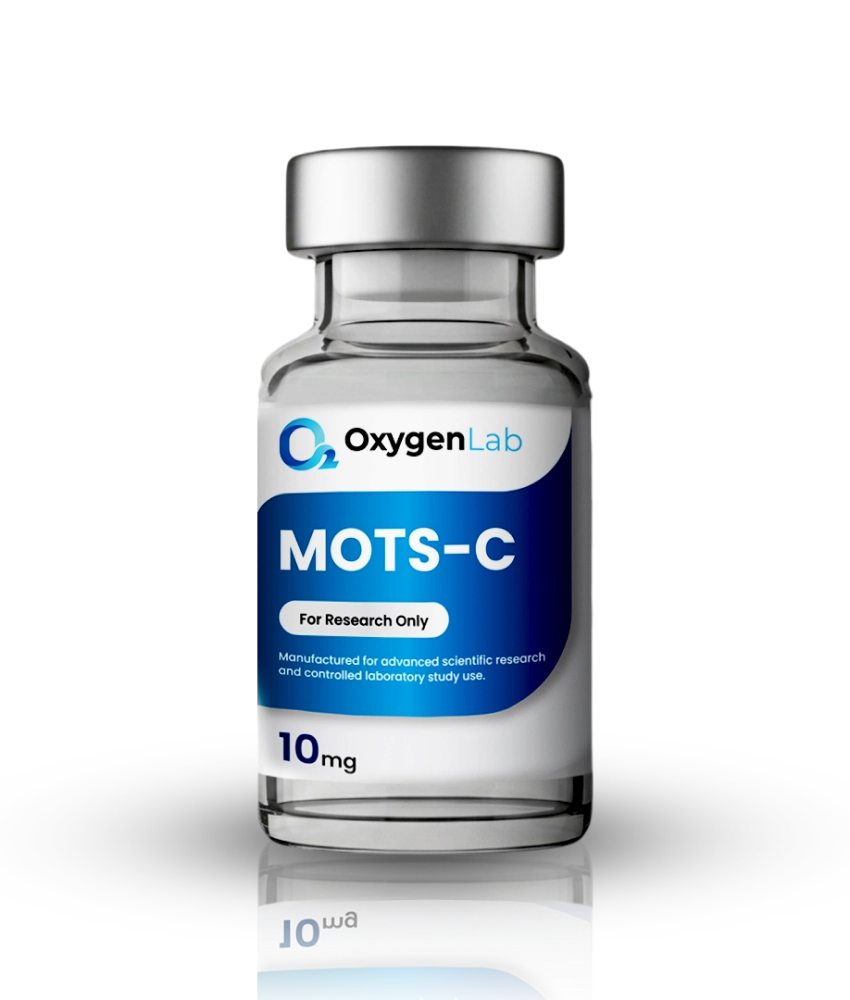
MOTS-c is a peptide encoded in mitochondrial DNA and studied in metabolism research. This overview covers its structure, discovery, research history and regulatory status. It is a scientific summary, not guidance on use.
Structure and origin
MOTS-c has the sequence Met-Arg-Trp-Gln-Glu-Met-Gly-Tyr-Ile-Phe-Tyr-Pro-Arg-Lys-Leu-Arg (MRWQEMGYIFYPRKLR), sixteen amino acids. It is encoded by a short open reading frame within the mitochondrial 12S rRNA gene. It was first described in 2015 by Pinchas Cohen’s group at the University of Southern California (Lee et al., Cell Metab, PMID 25738459). See the MOTS-c product page.
How MOTS-c has been studied
- Metabolism, diet-induced obesity and insulin resistance in mice (Lee et al., Cell Metab, 2015, PMID 25738459).
- Movement into the nucleus under metabolic stress (Kim et al., Cell Metab, 2018, PMID 29983246).
- Myostatin signalling in muscle (Kumagai et al., Am J Physiol Endocrinol Metab, 2021, PMID 33554779).
- Autoimmune diabetes models in mice (Kong et al., Cell Rep, 2021, PMID 34320351).
Exercise and age-related physical decline have also been studied (Reynolds et al., Nat Commun, 2021, doi:10.1038/s41467-020-20790-0). Endogenous MOTS-c has been measured in human blood, but the FDA reported in 2026 that it found no studies in which MOTS-c was administered to humans.
Regulatory status
- MOTS-c is not approved by the U.S. Food and Drug Administration for any use.
- In July 2026 the FDA Pharmacy Compounding Advisory Committee voted 7–5 to recommend MOTS-c for the compounding list. The vote is non-binding and FDA rulemaking is still required.
- MOTS-c is explicitly prohibited at all times by the World Anti-Doping Agency (class S4.4.1, since the 2024 list; see USADA).
Laboratories should confirm the current status in their jurisdiction before beginning work.
Quality considerations for researchers
Results depend on the material used, so identity and purity data matter. Check that each batch comes with a certificate of analysis showing mass-spectrometry identity and HPLC purity, and that the batch number matches your vial. Store lyophilized material as described in our storage guide.
Frequently asked questions
How many amino acids are in MOTS-c?
Sixteen.
Is MOTS-c produced naturally?
Yes. It is encoded in mitochondrial DNA and has been measured in human blood.
Is MOTS-c banned in sport?
Yes. It is named on the WADA prohibited list under S4.4.1.
Research use only. OxygenLab products are supplied for in-vitro laboratory research and analytical use only. They are not for human or animal use and are not intended to diagnose, treat, cure or prevent any disease. See our Legal & Compliance policy.
Lab tool: Working out solution concentration? Try the free OxygenLab Peptide Calculator — enter vial mass and diluent volume to get mg/mL, µg/mL and molarity.