
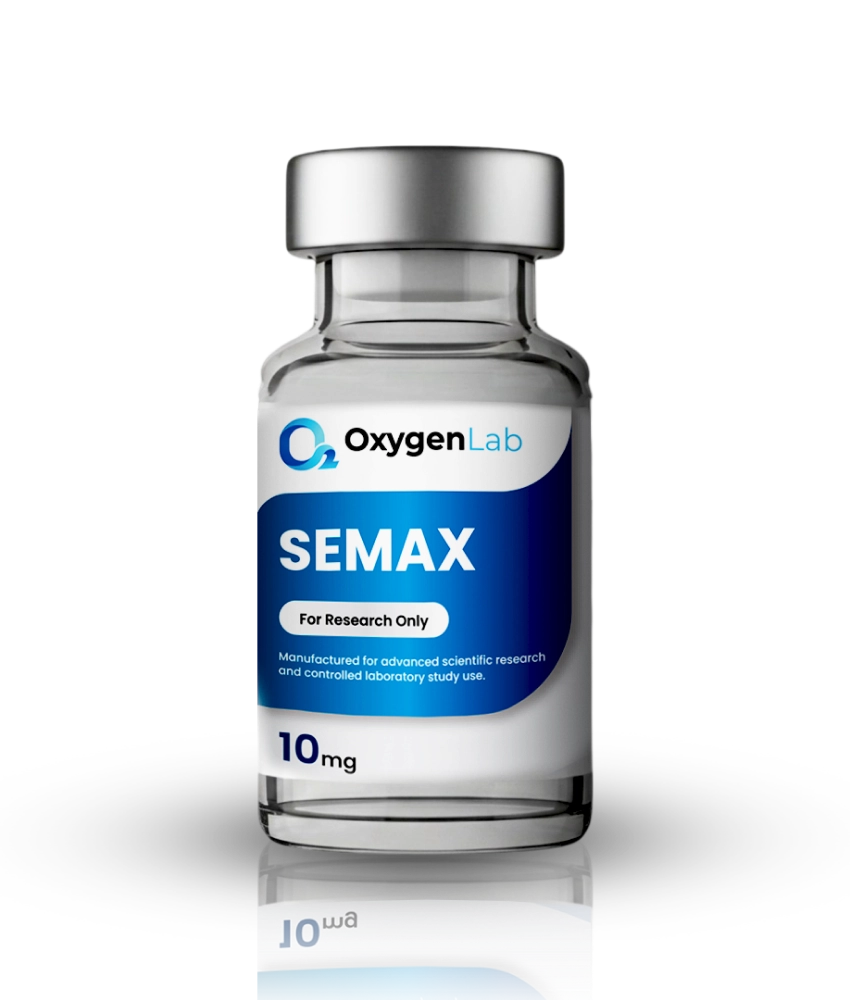
Semax is a synthetic heptapeptide studied mainly in neuroscience. This overview covers its structure, origin, research history and regulatory status. It is a scientific summary, not guidance on use.
Structure and origin
Semax has the sequence Met-Glu-His-Phe-Pro-Gly-Pro (seven amino acids). It is an analog of the ACTH(4-10) fragment: the ACTH(4-7) sequence Met-Glu-His-Phe joined to a Pro-Gly-Pro tail that increases its stability. It was developed at the Institute of Molecular Genetics of the Russian Academy of Sciences in Moscow. It is supplied for research as a lyophilized powder; see the Semax product page.
How Semax has been studied
- Early pharmacology of the peptide (Potaman et al., Biochem Biophys Res Commun, 1991, PMID 1851003).
- Brain-derived neurotrophic factor (BDNF) expression in rodent brain (Dolotov et al., J Neurochem, 2006, PMID 16635254).
- Dopamine and serotonin systems in rodents (Eremin et al., Neurochem Res, 2005, PMID 16362768).
- Gene expression in rat models of brain ischemia (Dmitrieva et al., Cell Mol Neurobiol, 2010, PMID 19633950).
- A Russian clinical study in ischemic stroke (Gusev et al., Zh Nevrol Psikhiatr, 2018, PMID 29798983).
In its 2026 review the FDA described the human evidence as insufficient. Much of the literature comes from a small number of Russian research groups.
Regulatory status
- Semax is not approved by the U.S. Food and Drug Administration for any use.
- It is registered as a medicine in Russia (nasal drops).
- In July 2026 the FDA Pharmacy Compounding Advisory Committee voted 8–5 to recommend Semax for the compounding list. The vote is non-binding and FDA rulemaking is still required.
- Semax is not named on the WADA prohibited list. Check Global DRO for current status.
Laboratories should confirm the current status in their jurisdiction before beginning work.
Quality considerations for researchers
Results depend on the material used, so identity and purity data matter. Check that each batch comes with a certificate of analysis showing mass-spectrometry identity and HPLC purity, and that the batch number matches your vial. Store lyophilized material as described in our storage guide.
Frequently asked questions
How many amino acids are in Semax?
Seven.
Is Semax the same as ACTH?
No. It is a short synthetic analog of an ACTH fragment with an added Pro-Gly-Pro tail.
How is Semax different from Selank?
Both were developed at the same Russian institute and end in Pro-Gly-Pro, but Semax is based on ACTH and Selank on tuftsin. See our Semax vs Selank comparison.
Research use only. OxygenLab products are supplied for in-vitro laboratory research and analytical use only. They are not for human or animal use and are not intended to diagnose, treat, cure or prevent any disease. See our Legal & Compliance policy.
Lab tool: Working out solution concentration? Try the free OxygenLab Peptide Calculator — enter vial mass and diluent volume to get mg/mL, µg/mL and molarity.