
Description
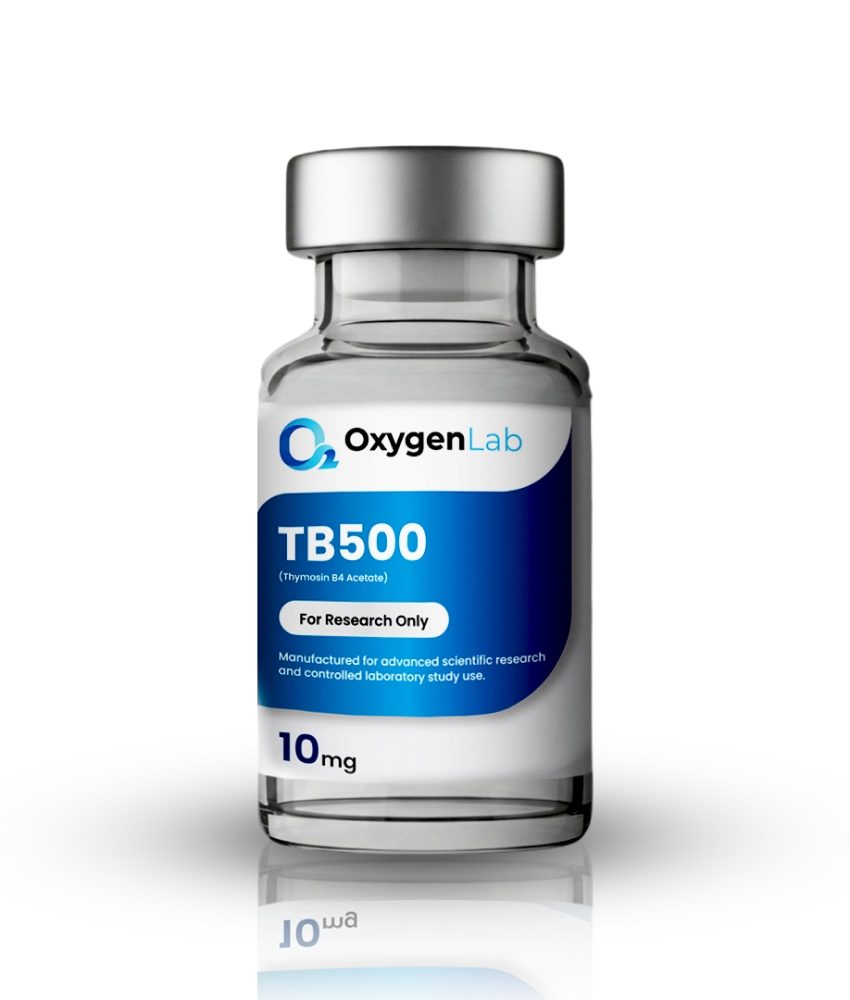
Thymosin beta-4 (Tβ4) is a 43-amino-acid, actin-sequestering peptide found in most mammalian cells. It is supplied here as the acetate salt. OxygenLab supplies TB-500 (Thymosin Beta-4) as a lyophilized powder (10 mg per vial), third-party tested; published certificates are on our COA page.
TB-500 (Thymosin Beta-4) Specifications
| Compound | TB-500 (Thymosin Beta-4) |
|---|---|
| Sequence / structure | Ac-SDKPDMAEIEKFDKSKLKKTETQEKNPLPSKETIEQEKQAGES (43 aa) |
| Molecular formula | C212H350N56O78S |
| Molecular weight | ≈4963 g/mol |
| CAS number | 77591-33-4 |
| Form | Lyophilized powder |
| Amount per vial | 10 mg |
| Purity | Third-party tested by HPLC and MS (COA available on request) |
Formula, molecular weight and CAS number per PubChem.
Research Overview
Tβ4 is studied for its role in actin regulation, cell migration and angiogenesis, using cell-culture and animal models of wound and tissue-repair biology.
Reviews describe it as a multi-functional regenerative peptide and outline the signalling pathways investigated to date.
Selected Research References
- beta-Thymosins, Ann N Y Acad Sci, 2007.
- Thymosin β4: a multi-functional regenerative peptide. Basic properties and clinical applications, Expert Opin Biol Ther, 2012.
TB-500 (Thymosin Beta-4): Research Background
Thymosin beta-4 was characterised in 1981 from thymosin fraction 5, a calf thymus extract. It is a 43-residue peptide and the main G-actin-sequestering molecule in many cell types.
Its actin-binding activity is centred on the LKKTETQ motif (residues 17–23). Research has studied Tβ4 in cell-migration, angiogenesis and wound models, including corneal, dermal and cardiac tissue; a 2004 Nature paper linked it to integrin-linked kinase signalling in cardiac models.
The N-terminal tetrapeptide Ac-SDKP, released by enzymatic cleavage, is studied separately in fibrosis research.
What the TB-500 (Thymosin Beta-4) COA Confirms
OxygenLab products are tested by independent third-party laboratories. HPLC reports purity as the main peak’s share of total peak area, and mass spectrometry confirms identity against the expected molecular weight of approximately 4963 g/mol. Published certificates are on our COA page, and others are available on request; match the lot number on your vial to the report before use in an experiment.
Related Research Compounds
Laboratories working with TB-500 (Thymosin Beta-4) often also reference: BPC-157, GLOW Blend, BPC-157 + TB-500 Blend.
More Questions About TB-500 (Thymosin Beta-4)
What is the actin-binding region of Thymosin Beta-4?
The LKKTETQ motif at residues 17–23.
Why are there 5 mg and 10 mg TB-500 vials?
The compound and testing are identical; the two sizes suit different laboratory batch sizes.
Storage and Handling
- Store lyophilized powder at -20°C for long-term storage, protected from light and moisture.
- Short-term storage at 2–8°C is acceptable for unopened vials.
- Allow the vial to reach room temperature before opening to limit moisture uptake.
- Record batch and lot numbers for every preparation.
Frequently Asked Questions
How is the purity of TB-500 (Thymosin Beta-4) verified?
OxygenLab products are tested by independent third-party laboratories for identity and purity (HPLC and mass spectrometry). A certificate for this product is available on request; contact us. Published certificates are on our COA page.
How should lyophilized TB-500 (Thymosin Beta-4) be stored?
Store unopened vials at -20°C, protected from light and moisture. Short-term storage at 2–8°C is acceptable.
Is TB-500 (Thymosin Beta-4) intended for human use?
No. TB-500 (Thymosin Beta-4) is sold strictly for laboratory research use and is not for human or animal consumption.
Related Research Guides
- BPC-157 vs TB-500: a research comparison
- How to read a peptide certificate of analysis
- What HPLC purity means for research peptides
- How to store lyophilized peptides
Research use only. This product is supplied for in-vitro laboratory research and analytical use only. It is not for human or animal use, and not intended to diagnose, treat, cure or prevent any disease. See our Legal & Compliance policy.
Reviews
There are no reviews yet.