
Description
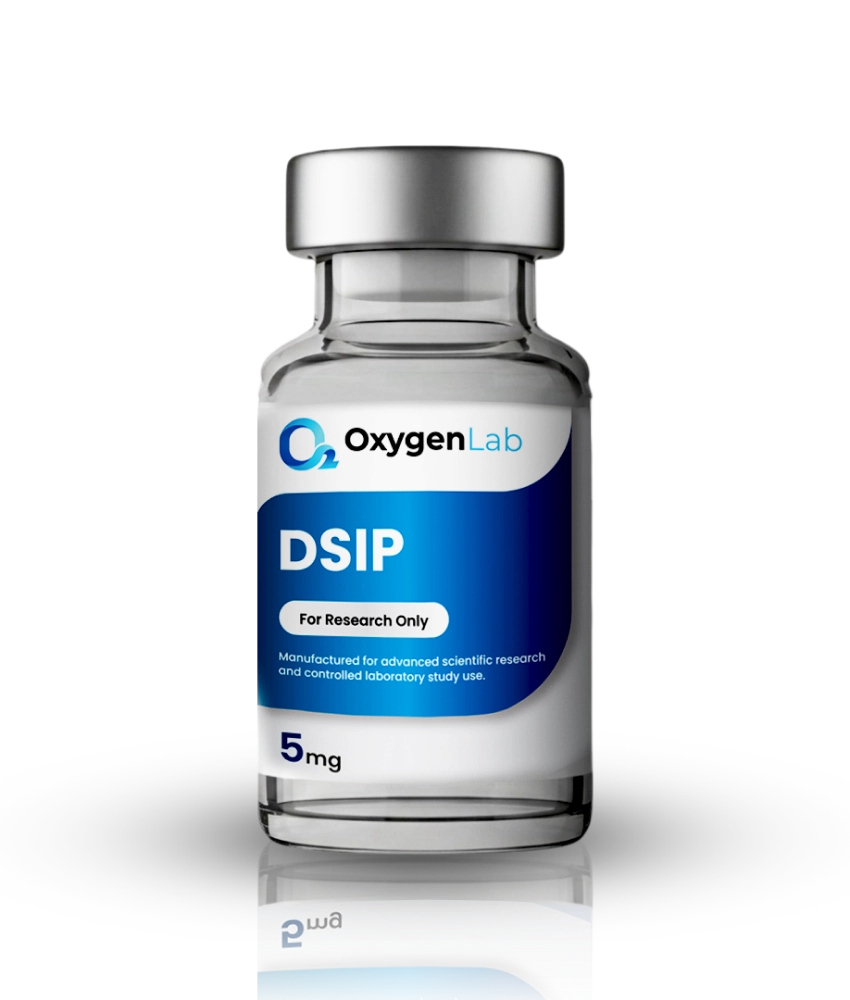
Delta sleep-inducing peptide (DSIP) is a nonapeptide first isolated from rabbit brain tissue in the 1970s. OxygenLab supplies DSIP as a lyophilized powder (5 mg per vial), third-party tested; published certificates are on our COA page.
DSIP Specifications
| Compound | DSIP |
|---|---|
| Sequence / structure | Trp-Ala-Gly-Gly-Asp-Ala-Ser-Gly-Glu (nonapeptide) |
| Molecular formula | C35H48N10O15 |
| Molecular weight | 848.8 g/mol |
| CAS number | 62568-57-4 |
| Form | Lyophilized powder |
| Amount per vial | 5 mg |
| Purity | Third-party tested by HPLC and MS (COA available on request) |
Formula, molecular weight and CAS number per PubChem.
Research Overview
DSIP has been studied in neuroendocrine and circadian research, and its biological role and receptor remain under investigation.
Reviews describe it as “a still unresolved riddle” and summarise decades of laboratory findings.
Selected Research References
- Delta sleep-inducing peptide (DSIP): a still unresolved riddle, J Neurochem, 2006.
- Delta-sleep-inducing peptide (DSIP): a review, Neurosci Biobehav Rev, 1984.
DSIP: Research Background
Delta sleep-inducing peptide was described in 1977 by Schoenenberger and Monnier in Basel, who isolated it from the cerebral venous blood of rabbits during electrically induced sleep and named it after the delta-wave EEG activity in those experiments.
Despite decades of research, no specific DSIP gene or receptor has been confirmed, which is why reviews still describe it as an unresolved puzzle. Laboratory studies have examined its effects on sleep architecture in animal models, stress-hormone responses and neuroendocrine signalling.
DSIP-like immunoreactivity has been reported in the hypothalamus, pituitary and plasma, which continues to drive interest in its physiological role.
What the DSIP COA Confirms
OxygenLab products are tested by independent third-party laboratories. HPLC reports purity as the main peak’s share of total peak area, and mass spectrometry confirms identity against the expected molecular weight of 848.8 g/mol. Published certificates are on our COA page, and others are available on request; match the lot number on your vial to the report before use in an experiment.
Related Research Compounds
Laboratories working with DSIP often also reference: Selank, Semax.
More Questions About DSIP
Where was DSIP first isolated?
From the cerebral venous blood of rabbits during electrically induced sleep, reported in 1977.
Has a DSIP receptor been identified?
No specific receptor has been confirmed, which remains one of the main open questions in DSIP research.
Storage and Handling
- Store lyophilized powder at -20°C for long-term storage, protected from light and moisture.
- Short-term storage at 2–8°C is acceptable for unopened vials.
- Allow the vial to reach room temperature before opening to limit moisture uptake.
- Record batch and lot numbers for every preparation.
Frequently Asked Questions
How is the purity of DSIP verified?
OxygenLab products are tested by independent third-party laboratories for identity and purity (HPLC and mass spectrometry). A certificate for this product is available on request; contact us. Published certificates are on our COA page.
How should lyophilized DSIP be stored?
Store unopened vials at -20°C, protected from light and moisture. Short-term storage at 2–8°C is acceptable.
Is DSIP intended for human use?
No. DSIP is sold strictly for laboratory research use and is not for human or animal consumption.
Related Research Guides
- How to read a peptide certificate of analysis
- What HPLC purity means for research peptides
- How to store lyophilized peptides
Research use only. This product is supplied for in-vitro laboratory research and analytical use only. It is not for human or animal use, and not intended to diagnose, treat, cure or prevent any disease. See our Legal & Compliance policy.
Reviews
There are no reviews yet.