
Description
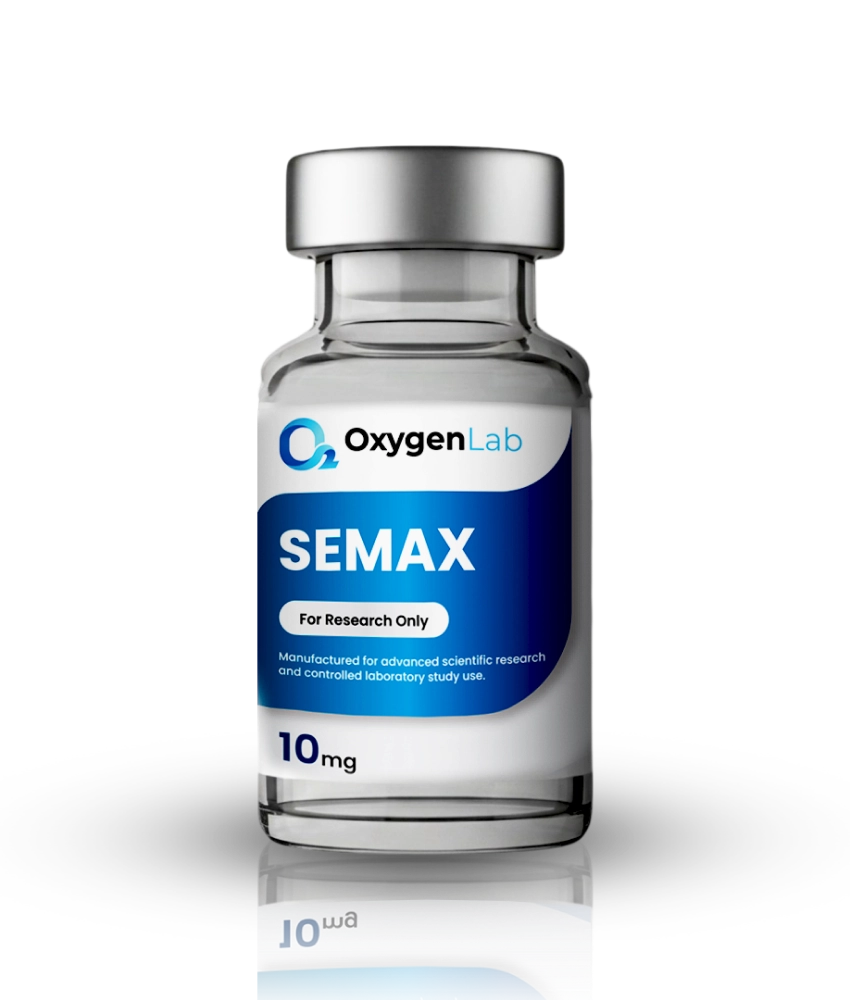
Semax is a synthetic heptapeptide based on the ACTH(4-10) fragment, extended with a Pro-Gly-Pro sequence. OxygenLab supplies Semax as a lyophilized powder (10 mg per vial), third-party tested; published certificates are on our COA page.
Semax Specifications
| Compound | Semax |
|---|---|
| Sequence / structure | Met-Glu-His-Phe-Pro-Gly-Pro (heptapeptide) |
| Molecular formula | C37H51N9O10S |
| Molecular weight | 813.9 g/mol |
| CAS number | 80714-61-0 |
| Form | Lyophilized powder |
| Amount per vial | 10 mg |
| Purity | Third-party tested by HPLC and MS (COA available on request) |
Formula, molecular weight and CAS number per PubChem.
Research Overview
Semax is studied in neuroscience research, including neurotrophic signalling and recovery models in rodents.
It is frequently studied alongside Selank in comparative neuropeptide research.
Selected Research References
- Semax peptide targets the μ opioid receptor gene Oprm1 to promote functional recovery after spinal cord injury, Br J Pharmacol, 2025.
- Functional Connectomic Approach to Studying Selank and Semax Effects, Dokl Biol Sci, 2020.
Semax: Research Background
Semax was developed at the Institute of Molecular Genetics of the Russian Academy of Sciences. Its core is the ACTH(4–7) fragment (Met-Glu-His-Phe); a C-terminal Pro-Gly-Pro tail was added to slow enzymatic breakdown.
Unlike full-length ACTH, Semax is reported not to have adrenal-stimulating (corticotropic) activity. Laboratory research focuses on neurotrophic signalling, including BDNF and TrkB expression in rodent brain tissue, and on transcriptome changes in rodent models of cerebral ischaemia.
Semax shares its Pro-Gly-Pro tail with Selank, and the two peptides are frequently compared in the same studies.
What the Semax COA Confirms
OxygenLab products are tested by independent third-party laboratories. HPLC reports purity as the main peak’s share of total peak area, and mass spectrometry confirms identity against the expected molecular weight of 813.9 g/mol. Published certificates are on our COA page, and others are available on request; match the lot number on your vial to the report before use in an experiment.
Related Research Compounds
Laboratories working with Semax often also reference: Selank, DSIP.
More Questions About Semax
Why does Semax end in Pro-Gly-Pro?
The tripeptide tail was added to the ACTH(4–7) core to make it more resistant to peptidases.
How is Semax related to Selank?
Both were developed at the same institute and share the Pro-Gly-Pro extension, but their core sequences differ (ACTH fragment vs. tuftsin).
Storage and Handling
- Store lyophilized powder at -20°C for long-term storage, protected from light and moisture.
- Short-term storage at 2–8°C is acceptable for unopened vials.
- Allow the vial to reach room temperature before opening to limit moisture uptake.
- Record batch and lot numbers for every preparation.
Frequently Asked Questions
How is the purity of Semax verified?
OxygenLab products are tested by independent third-party laboratories for identity and purity (HPLC and mass spectrometry). A certificate for this product is available on request; contact us. Published certificates are on our COA page.
How should lyophilized Semax be stored?
Store unopened vials at -20°C, protected from light and moisture. Short-term storage at 2–8°C is acceptable.
Is Semax intended for human use?
No. Semax is sold strictly for laboratory research use and is not for human or animal consumption.
Related Research Guides
- How to read a peptide certificate of analysis
- What HPLC purity means for research peptides
- How to store lyophilized peptides
Research use only. This product is supplied for in-vitro laboratory research and analytical use only. It is not for human or animal use, and not intended to diagnose, treat, cure or prevent any disease. See our Legal & Compliance policy.


Reviews
There are no reviews yet.