
Description
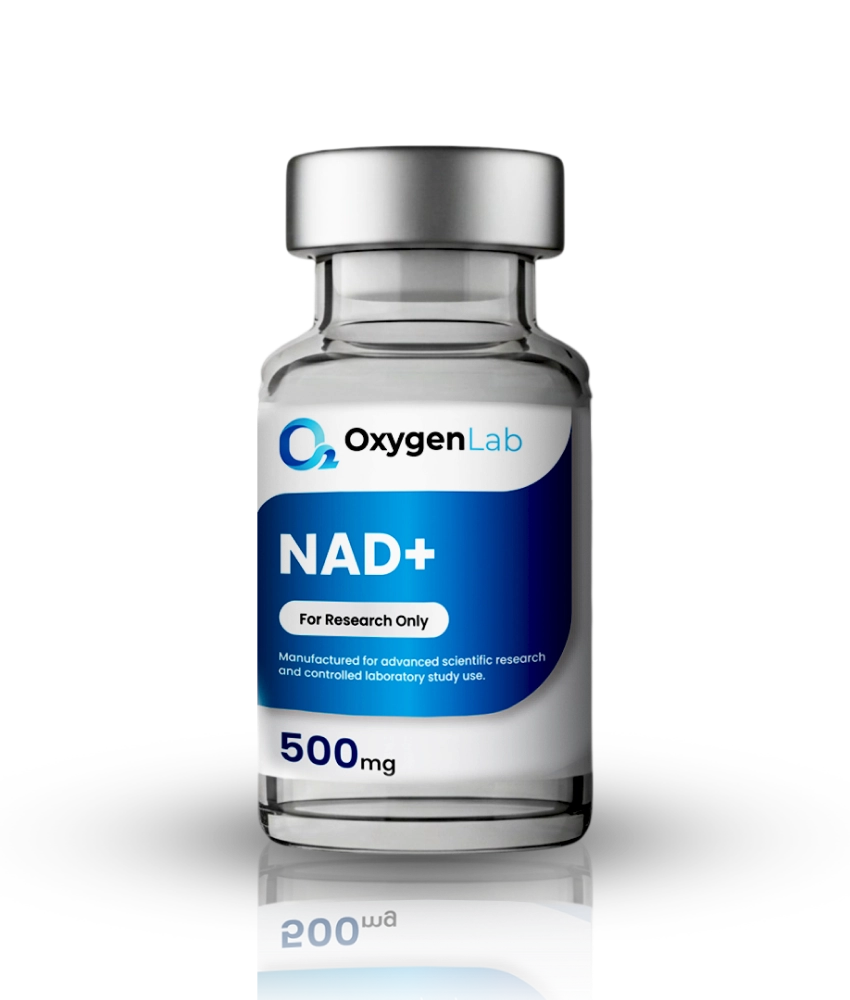
NAD+ (nicotinamide adenine dinucleotide) is a coenzyme central to cellular redox reactions and energy metabolism. OxygenLab supplies NAD+ as a lyophilized powder (500 mg per vial), third-party tested; published certificates are on our COA page.
NAD+ Specifications
| Compound | NAD+ |
|---|---|
| Sequence / structure | Not a peptide: nicotinamide adenine dinucleotide (coenzyme) |
| Molecular formula | C21H27N7O14P2 |
| Molecular weight | 663.4 g/mol |
| CAS number | 53-84-9 |
| Form | Lyophilized powder |
| Amount per vial | 500 mg |
| Purity | Third-party tested by HPLC and MS (COA available on request) |
Formula, molecular weight and CAS number per PubChem.
Research Overview
NAD+ is studied in metabolism and cellular-ageing research, including its role as a substrate for sirtuins and PARP enzymes.
Major reviews describe how NAD+ levels and metabolism change in ageing models.
Selected Research References
- NAD+ metabolism and its roles in cellular processes during ageing, Nat Rev Mol Cell Biol, 2021.
- NAD+ in aging, metabolism, and neurodegeneration, Science, 2015.
NAD+: Research Background
NAD+ is not a peptide but a dinucleotide coenzyme: two nucleotides, one containing nicotinamide and one adenine, joined by a pyrophosphate bridge. Cells make it through a de novo pathway from tryptophan, the Preiss-Handler pathway from nicotinic acid, and the salvage pathway in which NAMPT converts nicotinamide to NMN.
Beyond its role as an electron carrier (the NAD+/NADH pair), NAD+ is consumed as a substrate by sirtuins, PARP enzymes and CD38, which links NAD+ availability to DNA repair, protein deacetylation and signalling research.
Published reviews describe changes in NAD+ levels across ageing models, making it a common reference compound in metabolism and mitochondrial studies.
What the NAD+ COA Confirms
OxygenLab products are tested by independent third-party laboratories. HPLC reports purity as the main peak’s share of total peak area, and mass spectrometry confirms identity against the expected molecular weight of 663.4 g/mol. Published certificates are on our COA page, and others are available on request; match the lot number on your vial to the report before use in an experiment.
Related Research Compounds
Laboratories working with NAD+ often also reference: MOTS-c, Glutathione, Epithalon.
More Questions About NAD+
Is NAD+ a peptide?
No. It is a dinucleotide coenzyme, supplied alongside research peptides because it is used in the same mitochondrial and metabolic research areas.
Which enzymes consume NAD+?
Sirtuins, PARPs and CD38 use NAD+ as a substrate.
Storage and Handling
- Store lyophilized powder at -20°C for long-term storage, protected from light and moisture.
- Short-term storage at 2–8°C is acceptable for unopened vials.
- Allow the vial to reach room temperature before opening to limit moisture uptake.
- Record batch and lot numbers for every preparation.
Frequently Asked Questions
How is the purity of NAD+ verified?
OxygenLab products are tested by independent third-party laboratories for identity and purity (HPLC and mass spectrometry). A certificate for this product is available on request; contact us. Published certificates are on our COA page.
How should lyophilized NAD+ be stored?
Store unopened vials at -20°C, protected from light and moisture. Short-term storage at 2–8°C is acceptable.
Is NAD+ intended for human use?
No. NAD+ is sold strictly for laboratory research use and is not for human or animal consumption.
Related Research Guides
- How to read a peptide certificate of analysis
- What HPLC purity means for research peptides
- How to store lyophilized peptides
Research use only. This product is supplied for in-vitro laboratory research and analytical use only. It is not for human or animal use, and not intended to diagnose, treat, cure or prevent any disease. See our Legal & Compliance policy.
Reviews
There are no reviews yet.