
Description
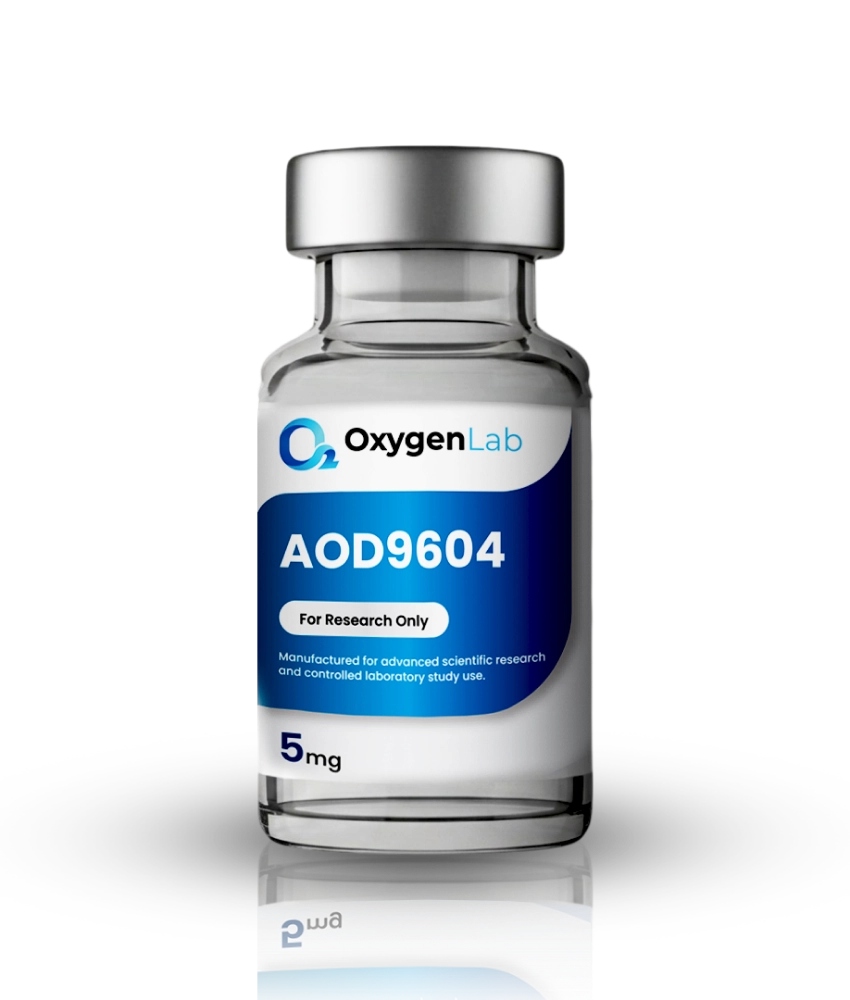
AOD-9604 is a synthetic 16-amino-acid fragment of human growth hormone (residues 177–191 with an added N-terminal tyrosine). OxygenLab supplies AOD-9604 as a lyophilized powder (5 mg per vial), third-party tested; published certificates are on our COA page.
AOD-9604 Specifications
| Compound | AOD-9604 |
|---|---|
| Sequence / structure | Tyr-hGH(177-191): YLRIVQCRSVEGSCGF (16 aa, disulfide-bridged) |
| Molecular formula | C78H123N23O23S2 |
| Molecular weight | 1815.1 g/mol |
| CAS number | 221231-10-3 |
| Form | Lyophilized powder |
| Amount per vial | 5 mg |
| Purity | Third-party tested by HPLC and MS (COA available on request) |
Formula, molecular weight and CAS number per PubChem.
Research Overview
AOD-9604 has been studied in metabolic research as a fragment of hGH, and in analytical chemistry for its detection and in-vitro metabolism.
Researchers use it to study how specific hGH regions behave independently of the full-length hormone.
Selected Research References
- Detection and in vitro metabolism of AOD9604, Drug Test Anal, 2015.
- AOD-9604 Metabolic, Curr Opin Investig Drugs, 2004.
AOD-9604: Research Background
AOD-9604 corresponds to residues 177–191 of human growth hormone, with an added N-terminal tyrosine. It was developed by researchers at Monash University, who studied the C-terminal region of hGH separately from the full-length hormone.
Published laboratory work examined the fragment in rodent adipose-tissue and lipid-metabolism models. Studies reported that it does not reproduce the full growth-promoting profile of intact hGH, which is why it is used to study how individual hormone regions behave.
AOD-9604 is also a subject of analytical chemistry research, including mass-spectrometry detection methods and in-vitro metabolism studies.
What the AOD-9604 COA Confirms
OxygenLab products are tested by independent third-party laboratories. HPLC reports purity as the main peak’s share of total peak area, and mass spectrometry confirms identity against the expected molecular weight of 1815.1 g/mol. Published certificates are on our COA page, and others are available on request; match the lot number on your vial to the report before use in an experiment.
Related Research Compounds
Laboratories working with AOD-9604 often also reference: CJC-1295 with DAC.
More Questions About AOD-9604
Which part of growth hormone is AOD-9604?
Residues 177–191 of human growth hormone, with an added tyrosine at the N-terminus.
Does AOD-9604 contain a disulfide bond?
Yes. The fragment contains two cysteines that form a disulfide bridge.
Storage and Handling
- Store lyophilized powder at -20°C for long-term storage, protected from light and moisture.
- Short-term storage at 2–8°C is acceptable for unopened vials.
- Allow the vial to reach room temperature before opening to limit moisture uptake.
- Record batch and lot numbers for every preparation.
Frequently Asked Questions
How is the purity of AOD-9604 verified?
OxygenLab products are tested by independent third-party laboratories for identity and purity (HPLC and mass spectrometry). A certificate for this product is available on request; contact us. Published certificates are on our COA page.
How should lyophilized AOD-9604 be stored?
Store unopened vials at -20°C, protected from light and moisture. Short-term storage at 2–8°C is acceptable.
Is AOD-9604 intended for human use?
No. AOD-9604 is sold strictly for laboratory research use and is not for human or animal consumption.
Related Research Guides
- How to read a peptide certificate of analysis
- What HPLC purity means for research peptides
- How to store lyophilized peptides
Research use only. This product is supplied for in-vitro laboratory research and analytical use only. It is not for human or animal use, and not intended to diagnose, treat, cure or prevent any disease. See our Legal & Compliance policy.
Reviews
There are no reviews yet.