
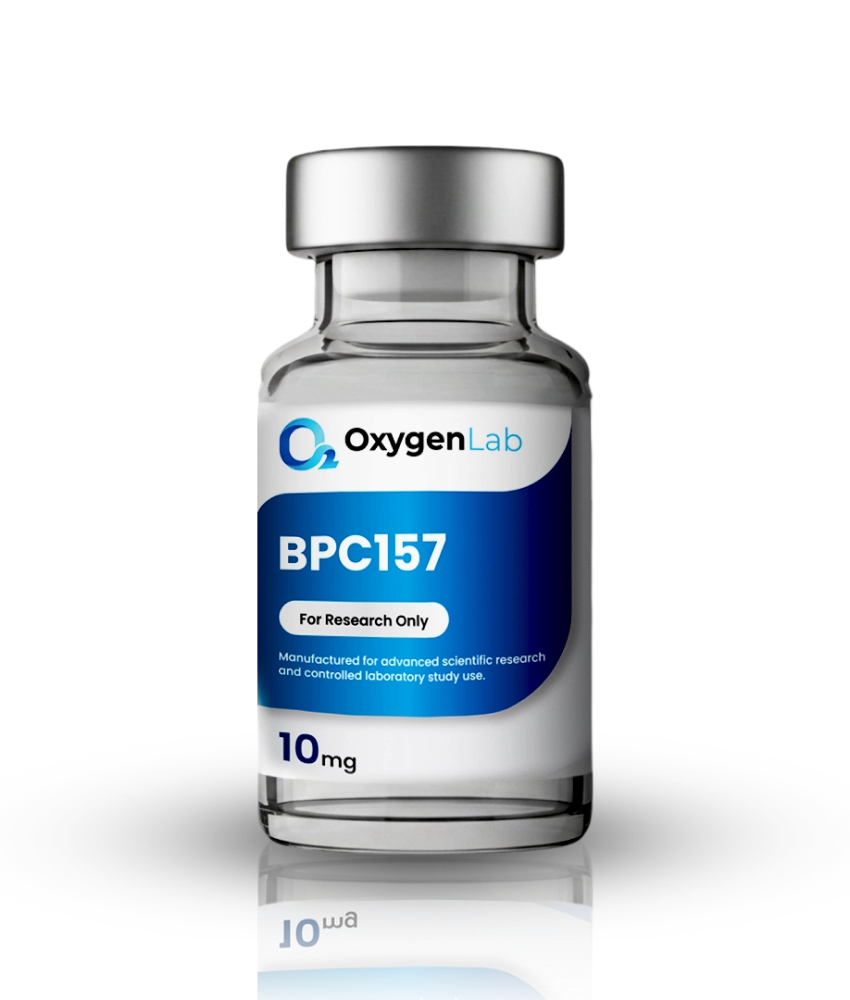
Description
BPC-157 is a synthetic 15-amino-acid peptide derived from a sequence found in human gastric juice protein (Body Protection Compound). OxygenLab supplies BPC-157 as a lyophilized powder (10 mg per vial), third-party tested; published certificates are on our COA page.
BPC-157 Specifications
| Compound | BPC-157 |
|---|---|
| Sequence / structure | Gly-Glu-Pro-Pro-Pro-Gly-Lys-Pro-Ala-Asp-Asp-Ala-Gly-Leu-Val (15 aa) |
| Molecular formula | C62H98N16O22 |
| Molecular weight | 1419.5 g/mol |
| CAS number | 137525-51-0 |
| Form | Lyophilized powder |
| Amount per vial | 10 mg |
| Purity | Third-party tested by HPLC and MS (COA available on request) |
Formula, molecular weight and CAS number per PubChem.
Research Overview
BPC-157 has been studied mainly in rodent and cell-culture models of tendon, ligament and gastrointestinal tissue, where researchers have examined its interaction with growth-factor signalling, angiogenesis and nitric-oxide pathways.
It is one of the most widely cited research peptides in the tissue-repair literature, and recent reviews summarise both the preclinical findings and the open questions that remain.
Selected Research References
- Gastric pentadecapeptide BPC 157 accelerates healing of transected rat Achilles tendon and in vitro stimulates tendocytes growth, J Orthop Res, 2003.
- Multifunctionality and Possible Medical Application of the BPC 157 Peptide: Literature and Patent Review, Pharmaceuticals, 2025.
BPC-157: Research Background
BPC-157 is a 15-residue partial sequence of a larger protein, termed body protection compound, that was described in gastric juice. Most of the published work comes from Predrag Sikiric’s group at the University of Zagreb.
Rodent and cell-culture studies have examined BPC-157 in tendon, ligament and gastrointestinal tissue models. Mechanistic papers describe interactions with the VEGFR2–Akt–eNOS pathway, nitric-oxide signalling, and FAK–paxillin signalling in tendon fibroblasts.
Reviews highlight that most data are preclinical, and they list open questions about mechanism and reproducibility, which continue to drive laboratory research.
What the BPC-157 COA Confirms
OxygenLab products are tested by independent third-party laboratories. HPLC reports purity as the main peak’s share of total peak area, and mass spectrometry confirms identity against the expected molecular weight of 1419.5 g/mol. Published certificates are on our COA page, and others are available on request; match the lot number on your vial to the report before use in an experiment.
Related Research Compounds
Laboratories working with BPC-157 often also reference: TB-500 (Thymosin Beta-4), BPC-157 + TB-500 Blend, GLOW Blend.
More Questions About BPC-157
How many amino acids are in BPC-157?
Fifteen: Gly-Glu-Pro-Pro-Pro-Gly-Lys-Pro-Ala-Asp-Asp-Ala-Gly-Leu-Val.
Why are there 5 mg and 10 mg BPC-157 vials?
The compound and testing are identical; the two sizes suit different laboratory batch sizes.
Storage and Handling
- Store lyophilized powder at -20°C for long-term storage, protected from light and moisture.
- Short-term storage at 2–8°C is acceptable for unopened vials.
- Allow the vial to reach room temperature before opening to limit moisture uptake.
- Record batch and lot numbers for every preparation.
Frequently Asked Questions
How is the purity of BPC-157 verified?
OxygenLab products are tested by independent third-party laboratories for identity and purity (HPLC and mass spectrometry). A certificate for this product is available on request; contact us. Published certificates are on our COA page.
How should lyophilized BPC-157 be stored?
Store unopened vials at -20°C, protected from light and moisture. Short-term storage at 2–8°C is acceptable.
Is BPC-157 intended for human use?
No. BPC-157 is sold strictly for laboratory research use and is not for human or animal consumption.
Related Research Guides
- What is BPC-157? A research overview
- BPC-157 vs TB-500: a research comparison
- How to read a peptide certificate of analysis
- What HPLC purity means for research peptides
- How to store lyophilized peptides
Research use only. This product is supplied for in-vitro laboratory research and analytical use only. It is not for human or animal use, and not intended to diagnose, treat, cure or prevent any disease. See our Legal & Compliance policy.
Reviews
There are no reviews yet.